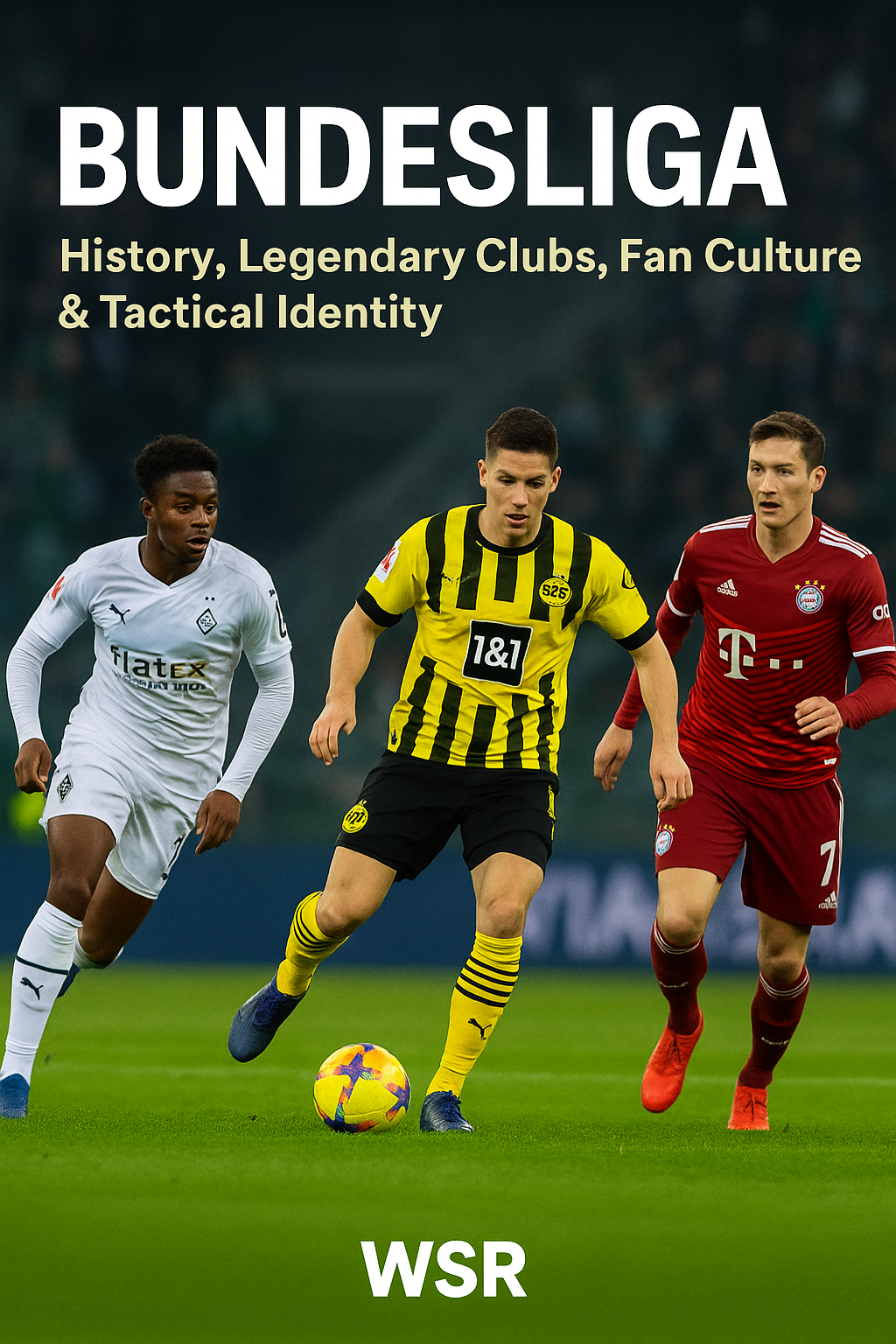
WorldSportsReports • Football League Foundation Series
Bundesliga Explained: History, Legendary Clubs, Fan Culture & Tactical Identity
A complete foundation report on German football’s elite league — its origins, governance model,
iconic clubs, youth development philosophy, and its unique position in modern world football.
WSR Editorial Hook
The Bundesliga is not just a football league — it is a blueprint. While many leagues prioritise
commercial expansion at all costs, German football chose a different path: sustainability,
supporter ownership, and structured development.
In this WorldSportsReports foundation guide, we explore how the Bundesliga was formed,
why it became Europe’s most stable league model, how its tactical identity evolved through decades,
and what a detailed SWOT analysis reveals about its strengths, limitations, and future direction
in an increasingly commercialised football world.
Introduction: What Is the Bundesliga?
The Bundesliga is the highest level of professional football in Germany and one of Europe’s most
respected domestic leagues. Established in 1963, it replaced a fragmented regional system with
a unified national league designed to improve competitiveness, professionalism, and player development.
Featuring 18 clubs each season, the Bundesliga is known for its fast-paced football, tactical discipline,
and extraordinary fan engagement. German stadiums regularly record the highest average attendances
in world football, reflecting a deep-rooted connection between clubs and their local communities.
Unlike leagues driven primarily by star power or global marketing, the Bundesliga’s identity is built
on structure, collective responsibility, and long-term planning — values that continue to shape its
competitive and cultural relevance.
and supporter inclusion rather than short-term commercial gain.
History and Evolution of the Bundesliga
The Bundesliga was founded in 1963 following Germany’s disappointing performance at the 1962 World Cup.
Football authorities concluded that the existing semi-professional regional leagues were no longer sufficient
to compete at the highest international level. A national professional league was required to modernise
German football from the ground up.
From its earliest years, the Bundesliga emphasised organisation, financial responsibility, and coaching education.
Clubs were required to meet strict licensing standards, ensuring long-term stability rather than reckless spending.
This philosophy helped German football rebuild credibility and competitiveness during the late 20th century.
In the modern era, the Bundesliga has become a global reference point for sustainable governance.
Its ability to balance elite competition with financial discipline and supporter involvement
distinguishes it from many wealth-driven league models.
Structure and Competition Format
The Bundesliga operates with 18 teams competing in a double round-robin format.
Each club plays 34 matches per season, facing every opponent twice.
Promotion and relegation link the league closely with the lower divisions,
maintaining competitive pressure and accountability.
While title races have often featured dominant clubs, the league remains highly competitive
in European qualification places and relegation battles. Tactical discipline, squad efficiency,
and physical preparation often determine outcomes across the table.
Achievements and Historic Records
German clubs have played a major role in European football history.
Bayern Munich’s sustained success in the UEFA Champions League established the Bundesliga
as one of Europe’s elite competitions, while Borussia Dortmund’s continental triumphs
highlighted the league’s competitive depth.
Beyond trophies, the Bundesliga is recognised for record-breaking attendances,
consistent national-team production, and structural continuity.
These achievements underline a league designed to perform at the highest level over decades,
not just during isolated golden eras.
Legendary Clubs and Players
Bayern Munich stand as the Bundesliga’s dominant force, symbolising efficiency,
elite recruitment, and winning culture. Borussia Dortmund represent youth-driven ambition,
attacking football, and one of the strongest fan identities in Europe.
Historic clubs such as Hamburg, Werder Bremen, and Schalke have also shaped the league’s narrative.
Legendary players elevated the Bundesliga’s global profile.
Franz Beckenbauer redefined defensive leadership, Gerd Müller set goal-scoring standards,
and Lothar Matthäus embodied midfield intelligence. In the modern era, Robert Lewandowski’s consistency
highlighted the league’s ability to develop and sustain elite talent.
Tactical Identity and Fan Culture
The Bundesliga is characterised by high-intensity pressing, vertical transitions,
and tactical organisation. German football combines athleticism with structure,
producing teams that operate at high tempo while maintaining positional discipline.
Equally important is fan culture. The Bundesliga’s 50+1 ownership rule preserves supporter influence,
keeping ticket prices accessible and stadium atmospheres among the best in world football.
This cultural foundation reinforces loyalty, stability, and long-term engagement.
Youth Development and Talent Pipeline
Germany’s football revival is closely linked to its youth development system.
Bundesliga academies emphasise tactical education, athletic preparation, and psychological development,
ensuring players are prepared for elite-level demands.
This focus on development allows clubs to remain competitive while controlling costs,
making youth investment a cornerstone of Bundesliga sustainability.
Bundesliga SWOT Analysis (WSR Strategic Insight)
Strengths
The Bundesliga’s strongest asset is its sustainable governance model.
Financial discipline, supporter ownership, elite academies, and a clear tactical identity
provide long-term stability unmatched by many other leagues.
Weaknesses
Commercial revenue remains lower than England and Spain, limiting global marketing reach.
Long-term dominance by a small number of clubs has also raised concerns about competitive balance.
Opportunities
Digital expansion, youth export markets, and increasing global interest in sustainable football
models offer significant growth potential for the Bundesliga.
Threats
Pressure to relax ownership regulations, rising wage inflation, and competition from wealthier leagues
remain long-term strategic challenges.
Final WSR Verdict
The Bundesliga stands as football’s most sustainable elite league.
While it may not always match others in commercial scale, its emphasis on youth development,
supporter culture, and structural integrity ensures long-term relevance and global respect.
In an era of rapid commercialisation, the Bundesliga remains proof that football can grow
without losing its core values.
About the Author
